Gifting Culture · 6 min read
The Art of Gifting in Indian Culture
By Astha, Co-founder of Sutra Gifting · 10 January 2026
The art of gifting in Indian culture
In India, gifting is a social language. Timing, presentation, and the relationship between giver and receiver carry as much meaning as the object itself. It's one of the main ways relationships are kept alive, not just a thing you do at milestones. The same box of sweets means something completely different at a wedding, a promotion, a new home, or a hospital visit — the context is the message.
In a lot of places, a gift is a transaction in nice paper. You spend money, you wrap it, you hand it over. In India it doesn't quite work like that, and most of us grow up fluent in the difference without ever being taught it.
Gifting as how relationships are kept
In Indian life, gifting is one of the clearest ways relationships are maintained. Not just celebrated at the big moments, but kept warm through small, constant exchange.
Think of the quiet gifting that happens all the time. The laddoos a colleague brings back from a trip. The fruit sent to someone unwell. The sweets handed around after a child's results. None of it is required. All of it is understood as necessary. Relationships here are demonstrated, not assumed, and a gift is one of the plainest ways to say: I thought of you, this matters to me. Not giving, at the moment one is expected, says something too.
The occasions that shape it
Every culture has a gifting calendar. India's is unusually full.
Diwali is the biggest, and close to universal across generations and contexts. Businesses gift clients, families exchange hampers, neighbours drop off sweets. Raksha Bandhan is specifically about siblings, where the gift is part of the ritual itself. Eid centres on Eidi and shared sweets, inseparable from the celebration. Weddings are a whole ecosystem of their own — the gift to the couple, the return gifts for guests, the gifts for the people who made it happen, each with its own expectations. Births, promotions, housewarmings, retirements all carry their own logic. The gift marks the milestone and places the giver inside the recipient's story.
What makes a gift land
There's no single formula, but a few things hold across the diversity of it.
Timing. A Diwali gift that arrives after Diwali isn't a Diwali gift, it's a late one, and it reads differently. The same object at the right moment versus the wrong one is a different gesture entirely.
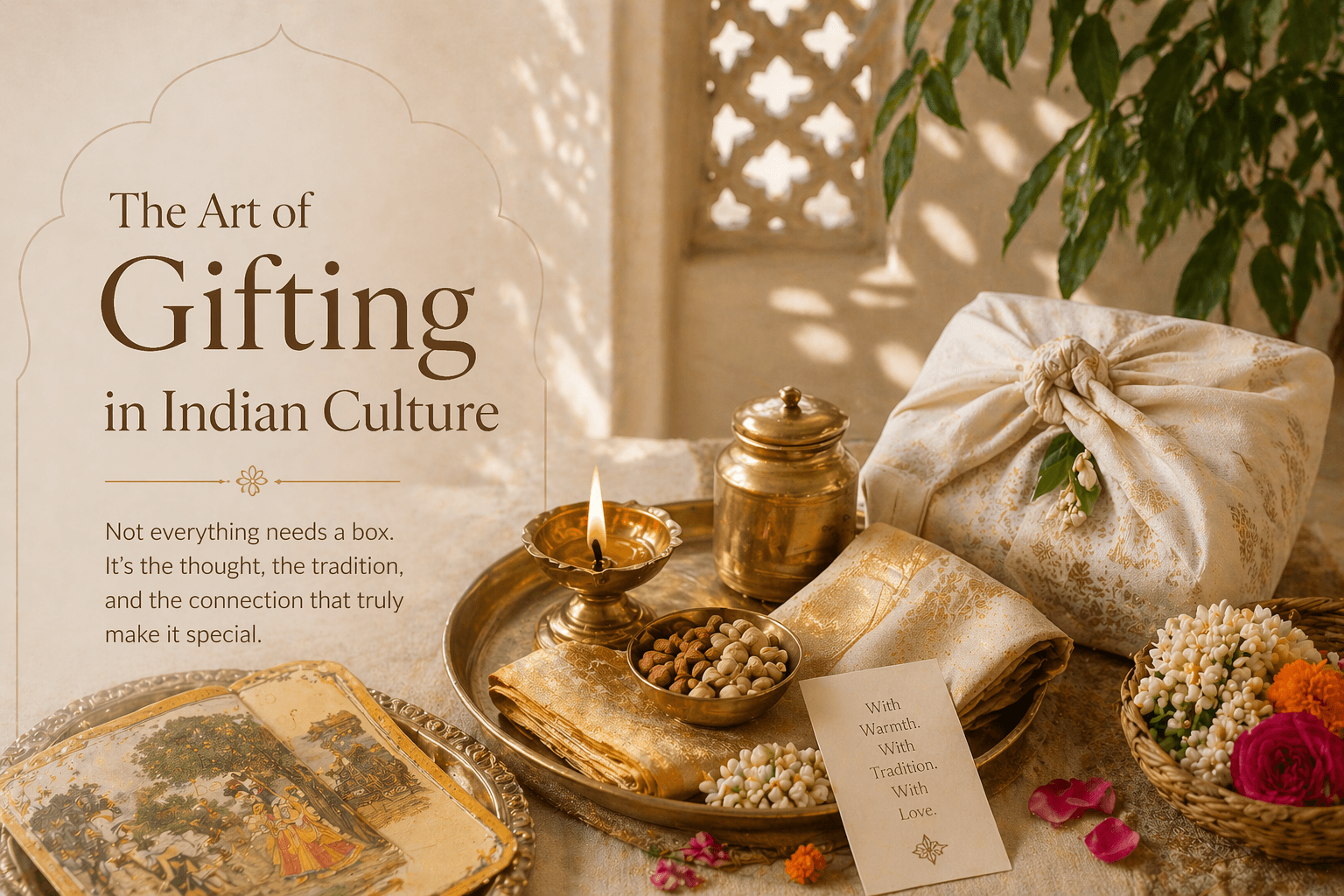
Presentation. How something arrives is part of what it says. A well-wrapped gift signals you thought about how it would be received, not only what was inside.
A specific note. Even a short handwritten line changes a gift from a transaction into a gesture. "Wishing you joy" is forgettable. "I know how hard you worked for this" is not.
Scale that fits the relationship. Too lavish for someone you barely know creates discomfort. Too modest for someone close reads as inattention. Getting this right is part of the social intelligence gifting quietly asks for.
A few nuances worth knowing
India isn't one gifting culture but dozens, layered together. In many contexts, cash is the most valued gift, especially at weddings, where it's practical and chosen by the receiver. Some items carry weight: knives are considered inauspicious in some traditions, clocks are avoided in others. Good food is the most reliably welcome category across the board, because it gets shared and consumed rather than stored. And at weddings and large events, what guests carry home reflects on the hosts, so return gifts deserve real thought.
On "luxury," and what's changing
There's a shift we notice constantly in our own work. People increasingly want to know where a gift came from, and somewhere along the way that knowledge started to feel like a premium feature. We'd push back on that gently. Traceability isn't luxury. It's just what happens when there's no one standing between you and the source.
If anything, the real luxury in Indian gifting now is rareness, not expense — rare to know exactly where everything came from, rare to have actual craft at every layer, rare to give something that honours the maker as much as the recipient. Curated hampers have replaced generic boxes as the thing people aspire to send, because a curated gift is a point of view about the person and a generic one is the absence of one. The bar for "personal" has risen past a name sticker. And younger recipients now notice packaging waste, so materials that can be kept have quietly become part of what makes a gift feel generous.
What hasn't changed
A gift is still a way of saying: you matter to me, I thought about you, I wanted to mark this. The object is almost beside the point. What it carries — the attention, the timing, the care taken for this particular person — is what gets remembered. That part of Indian gifting has never really moved.
Explore the occasion guides: Diwali gifting → · corporate gifting →. Or say hello on WhatsApp →.
Frequently asked questions
- Why is gifting so important in Indian culture?
- Because in India gifting is how relationships are maintained, not just how milestones are marked. It runs continuously — sweets after good news, fruit to someone unwell, hampers at every festival. To give is to say you thought of someone. Not giving at an expected moment is noticed just as clearly.
- What are the main gifting occasions in India?
- Diwali is the largest and most universal. Raksha Bandhan, Eid, weddings, births, promotions, housewarmings, and retirements each carry their own gifting logic. The Indian calendar is unusually full of occasions, so gifting is close to continuous through the year.
- What should you avoid gifting in India?
- In some traditions, sharp objects like knives are considered inauspicious, and clocks carry an association with time running out. These aren't universal, but they're worth knowing. Good food — quality sweets, single-origin pantry goods, well-made snacks — is close to universally safe across regions and generations.
- Is cash an acceptable gift at Indian weddings?
- Yes. In many communities cash is not just accepted but expected at weddings and large celebrations. It's practical and chosen by the recipient. A curated hamper works best when you want to make a more personal impression rather than a purely practical one.
- How is Indian gifting culture changing?
- Curated hampers have replaced generic boxes as the format people aspire to. Younger recipients notice packaging waste and prefer materials they can keep. The bar for 'personal' has risen past a name on a label. And gifts are now researched online and shared socially, so a good unboxing has a second life.