Gifting Ideas · 6 min read
Diwali Gifting Trends: What's Actually Changing This Season
By Astha, Co-founder of Sutra Gifting · 20 February 2026
Diwali gifting trends: what's actually changing this season
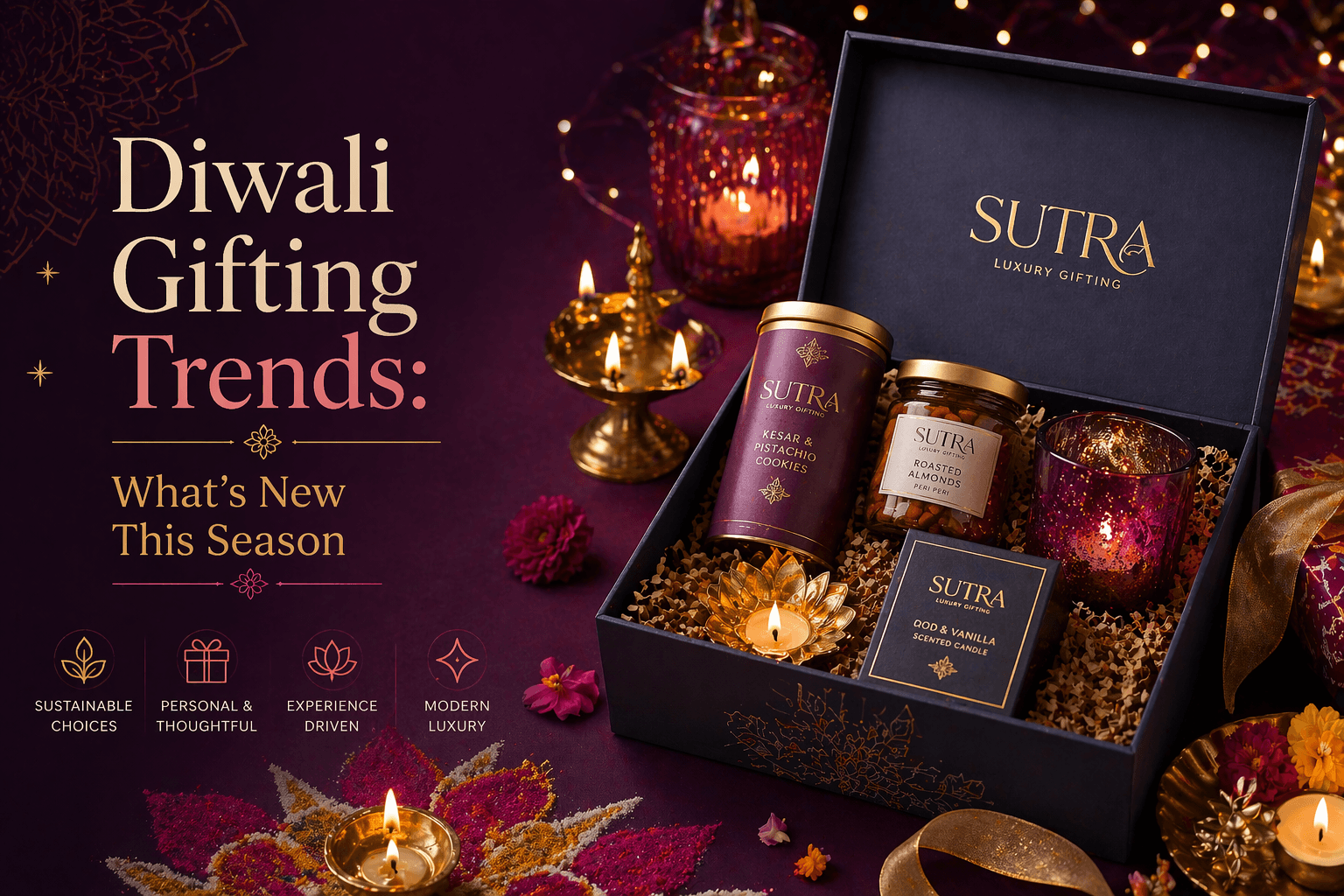
The clearest shift in Diwali gifting right now is away from the generic and toward the specific: regional and single-origin food, fewer-but-better hampers, packaging meant to be kept, and curation that reflects who the recipient actually is. The mixed dry-fruit tin is on its way out, not because of what's in it, but because it says nothing.
Every Diwali shifts a little. What felt fresh two years ago becomes the default, and the niche becomes the norm. We see this from an odd angle — we make the gifts, so we watch what people ask for change in real time. Here's what's moving this season and why it's worth following.
Where it's coming from matters now
The most interesting change isn't a product. It's that people increasingly want to know where a gift came from. Honey from a named apiary. Ghee from a single herd. A textile from one cooperative. Provenance has become part of the gift.
We feel this one personally. Our edibles come from a single farm, and the questions we get now aren't "is it nice" but "where is it grown, who makes it." A gift you can trace carries a small story, and a story turns an object into a conversation. "This is single-origin, from one farm in Chhattisgarh" does more across a room than any amount of gold ribbon.
In practice: regional sweets instead of a mixed box, single-origin pantry goods, craft tied to a specific place and maker.
Fewer gifts, better ones
The other clear shift is people tightening their list and spending more on each name. A ₹2,500 gift that genuinely lands does more for a relationship than five ₹500 tokens forgotten by morning. The comfortable middle this season sits around ₹1,500–₹3,000 per gift, chosen for the person rather than for the price point.
Wellness, because Diwali is about renewal
Diwali is about light and starting fresh, and a wind-down or self-care set fits that better than another tray of sweets. A bath oil, a good candle, herbal teas; or a slow-morning set with chai, a handmade mug, dark chocolate. It works across ages and genders, which is why it's become one of the most reliable categories going.
Packaging that earns a second life
Two years ago, eco-friendly packaging was a differentiator. Now it's expected, especially by younger recipients. But the considered version isn't recycled cardboard — it's packaging designed to be kept. A fabric potli that becomes a pouch. A terracotta jar that stays in the kitchen. We use materials like terracotta, rice husk, and jute for exactly this reason: each is chosen because it has a use after the gift, not because it photographs as "sustainable." When the wrapper survives, so does the memory of the gift.
Experiences, alongside or instead
Physical gifts are increasingly paired with experiences — a dinner the recipient's been meaning to try, a tasting set up at home, a class. It works especially well for people who already have everything. For Diwali it usually shows up as either a clean experience voucher, or a hamper that sets up one good evening at home.
Personal, beyond a name sticker
Personalisation used to mean a name on the box. That's table stakes now. What's growing is curation that reflects the actual person — the colleague who lives on filter coffee, the friend trying to read more this year. A name on a generic hamper is a label. A hamper built around what someone's into is a gift. The second one takes knowing them, which is exactly why the generic version feels hollow.
What's quietly being retired
The mixed dry-fruit tin. A long, undistinguished run. The issue isn't dry fruit — it's the absence of a choice. The same category, chosen with intent (one specific variety, from a known producer), reads completely differently.
Logo merchandise as gifts. Branded mugs, pens, and totes are promotional items. Employees can tell the difference between a gift and inventory.
Last-minute everything. The gifts that go wrong — late, rushed, in a plain brown box — are nearly always last-minute. The unboxing is the first impression, and haste shows even when the product inside is good.
What to look for this year
Specificity over variety. Three excellent things beat ten mediocre ones. Packaging that's considered, not elaborate, ideally something keepable. A card that actually says something. And delivery you can count on — a Diwali gift that arrives after Diwali is a logistics failure in festive wrapping.
Buying for a team this year? Here's the full corporate Diwali playbook →, or tell us what you're planning on WhatsApp →.
Frequently asked questions
- What is the most popular Diwali gift in 2026?
- Curated hampers built around regional or single-origin food are where the demand has clearly moved. Wellness sets and small experiences are growing too, especially with urban recipients. The standard mixed dry-fruit box is fading, not because dry fruit is bad, but because it signals no thought.
- What is a good Diwali gift under ₹2,000?
- Two or three things that belong together, in packaging that feels considered — a single-origin sweet and a regional specialty, or a small wind-down set with a candle and good tea. One excellent item beats a padded assortment at this budget every time.
- Are sustainable gifts actually appreciated at Diwali?
- Yes, especially packaging that can be kept and reused. But lead with the gift itself. Sustainability lands as a quiet bonus, not as the headline. Packaging that has a second life — a tin, a jar, a fabric wrap — just makes a good gift feel more generous.
- What is the best Diwali gift for someone who has everything?
- Go specific or go experiential. A hamper built around the one thing they're genuinely into, or an evening set up at home, beats anything generic. For someone who lacks nothing, the only gift that lands is one that proves you were paying attention.